

Cystatin C: The Kidney Test That Does Not Get Confused by Muscle
Cystatin C measures kidney function independently of muscle mass — making it essential for muscular men on TRT. Modern Men's Clinic, South Carolina.
Cystatin C: The Kidney Test That Does Not Get Confused by Muscle
Why this advanced marker is becoming the standard for men on testosterone replacement therapy
For most of the history of clinical laboratory medicine, creatinine has been the default marker for kidney function. It is inexpensive, widely available, and reasonably reliable — in the general population. But for men who carry significant muscle mass, or who are building muscle on testosterone replacement therapy, creatinine has a well-recognized blind spot. It rises with muscle growth, creating an interpretive ambiguity that can obscure true kidney function.
Cystatin C is an alternative kidney filtration marker that does not share this limitation. It is produced at a constant rate by virtually all nucleated cells in the body — independent of muscle mass — and is cleared by the kidneys in a manner that closely parallels creatinine. For muscular men and men on TRT, cystatin C provides a significantly more accurate picture of kidney filtration.
What Is Cystatin C?
Cystatin C is a small protein produced by virtually all cells at a constant, predictable rate. Like creatinine, it is freely filtered by the glomeruli (the kidney's filtering units), and its serum level reflects how efficiently the kidneys are clearing it. Unlike creatinine, its production rate is not influenced by muscle mass, dietary protein intake, or exercise — which means changes in cystatin C more reliably reflect changes in actual kidney function rather than changes in body composition.
Cystatin C is used to calculate cystatin C-based eGFR, which has been shown in research to be a more accurate measure of kidney filtration in certain populations — including muscular men.
Normal Reference Ranges
| Category | Range |
|---|---|
| Normal cystatin C (adult) | 0.52–1.00 mg/L |
| Mildly elevated | 1.00–1.30 mg/L |
| Elevated (kidney function concern) | > 1.30 mg/L |
What Does It Mean for the Body?
When cystatin C is elevated in a man whose creatinine is also elevated, the clinical concern for genuine kidney impairment is stronger. When cystatin C is normal but creatinine is elevated, the most likely explanation is increased creatinine production from higher muscle mass — a reassuring finding in a man who has been actively building lean tissue on TRT.
This distinction — cystatin C as a "tiebreaker" for ambiguous creatinine results — is one of its most clinically valuable applications.
What Does It Mean on TRT or Hormone Therapy?
As discussed in Article 12, TRT-related muscle growth can raise creatinine without any kidney impairment. Cystatin C allows providers to confidently distinguish this scenario from true renal decline. For men on long-term TRT, including cystatin C in periodic monitoring adds an important layer of confidence to kidney safety surveillance.
What Does It Mean for Weight Loss Patients?
Body composition shifts during significant weight loss — including loss of lean mass — can also affect creatinine. Cystatin C remains an independent, reliable marker during these transitions, providing a consistent reference point for kidney function regardless of what is happening to body composition.
Why We Check It — and How Often
| Timing | Reason |
|---|---|
| Baseline or when creatinine is ambiguous | Distinguish muscle mass effect from kidney impairment |
| Annually on long-term TRT | Comprehensive kidney health monitoring |
| With significant body composition changes | Reliable reference during transitions |
What Can Affect This Lab Value?
- Thyroid dysfunction: Hypothyroidism raises cystatin C; hyperthyroidism may lower it
- Corticosteroid use: High-dose corticosteroids can elevate cystatin C
- Inflammatory states: Systemic inflammation may transiently affect cystatin C
- Age: Cystatin C rises modestly with age, independent of kidney disease
- Body fat (not muscle mass): Some research suggests adipose tissue produces small amounts of cystatin C, though the effect is minor
Medical Disclaimer: The information in this article is for educational purposes only and is not intended as medical advice, diagnosis, or treatment. Lab reference ranges vary by laboratory, age, and individual health status. Always consult a licensed medical professional before making any changes to your health care regimen.
If you'd like to better understand what your lab results mean for your overall health, the team at Modern Men's Clinic in Powdersville, SC is here to help. We offer comprehensive hormone and metabolic lab panels as part of our TRT, medical weight loss, and hormone management programs — with personalized consultations led by John Garren, NP-C. Serving Greenville, Anderson, Easley, Pickens, and all of Upstate South Carolina, with telehealth available statewide. Call us at 864-689-3194 or visit modernmensclinics.com.
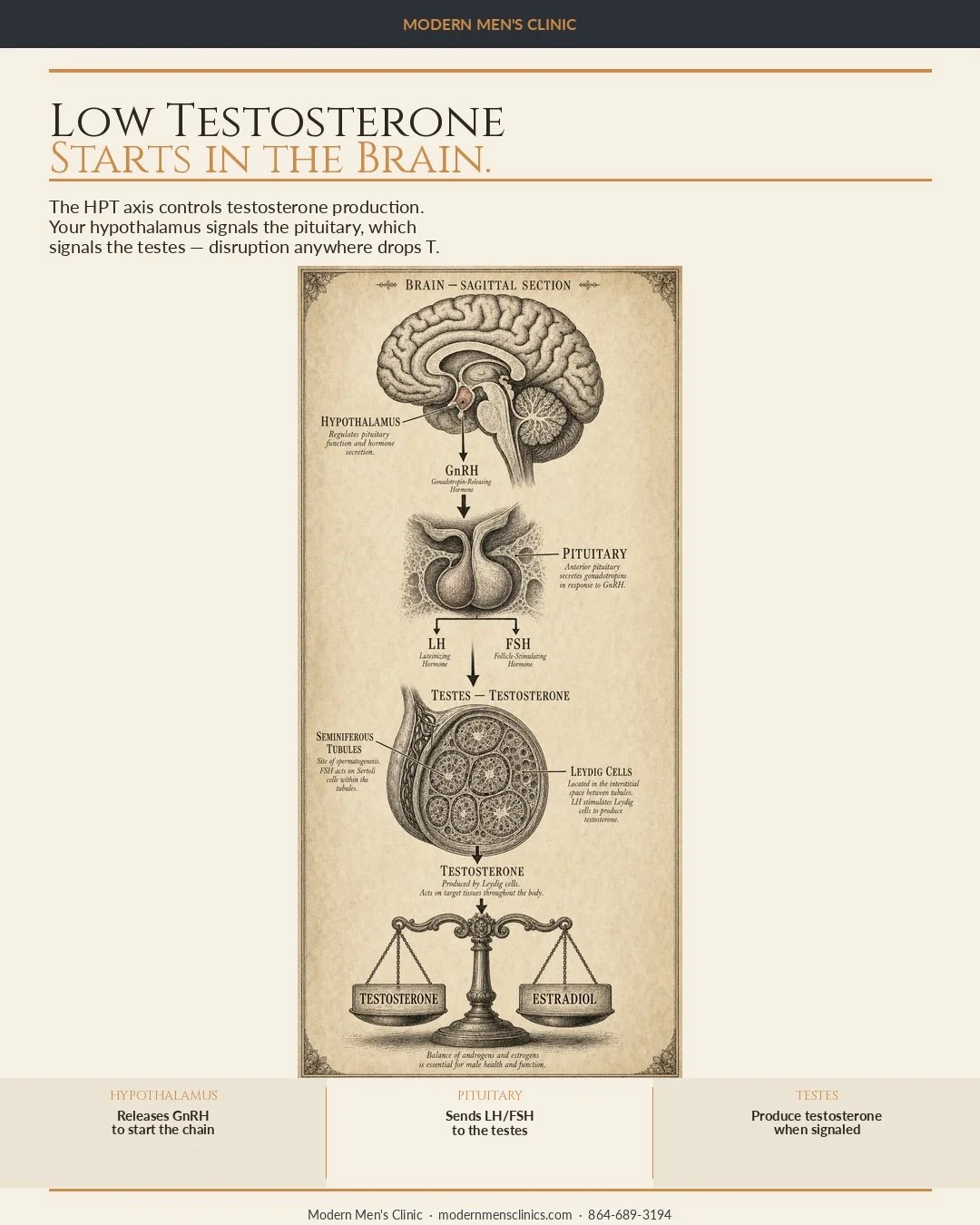
7 Signs You May Need Testosterone Replacement Therapy — And What to Do About It
Most men do not wake up one day and think, "I think my testosterone is low." Instead, it is a slow drift — a gradual erosion of the energy, strength, mood, and drive they once took for granted.
By the time most men walk through our door at Modern Men's Clinic, they have been living below their potential for years — often dismissing what they feel as stress, age, or just life.
“How did I get here”
Most men do not wake up one day and think, "I think my testosterone is low." Instead, it is a slow drift — a gradual erosion of the energy, strength, mood, and drive they once took for granted.
By the time most men walk through our door at Modern Men's Clinic, they have been living below their potential for years — often dismissing what they feel as stress, age, or just life.
Here are seven signs that what you are experiencing may be more than that.
1. You Are Exhausted — All the Time
Not tired after a long week. Bone-deep fatigue that does not respond to rest. If you are sleeping seven or eight hours and still waking up feeling like you barely slept, your hormones deserve a look.
Testosterone plays a direct role in energy metabolism. When levels drop, so does your ability to feel genuinely rested and alert.
2. Your Body Composition Has Shifted
More fat around the middle. Less muscle, even if you are still training. Testosterone is a key driver of both fat metabolism and muscle protein synthesis. When it drops, your body starts storing fat more efficiently — and building muscle becomes an uphill battle.
3. Your Sex Drive Has Faded
A reduced interest in sex is one of the most common early indicators of low testosterone. This is not about age — it is about hormone levels. Many men find that restoring testosterone to an optimal range significantly revives libido and sexual confidence.
4. Erections Are Less Reliable
Testosterone does not act alone in sexual function, but it is a major player. Difficulty achieving or maintaining erections — especially in the absence of cardiovascular disease or other known causes — is often tied to hormonal imbalance.
5. Your Mood Has Changed
Irritability, low motivation, mild depression, a sense of emotional flatness — these are real neurological symptoms of testosterone deficiency. If you find yourself feeling unlike yourself emotionally, it is worth ruling out a hormonal root cause before assuming it is purely psychological.
6. Brain Fog Is a Daily Reality
Struggling to focus? Finding it harder to retain information or think clearly? Testosterone has a direct impact on cognitive function. Many patients on TRT report that improved mental clarity was one of the first and most welcome changes they noticed.
7. You Have Lost Your Drive
Not just for sex — for life. The ambition, competitiveness, and sense of purpose that once felt natural have dulled. Testosterone influences motivation at a neurochemical level. Restoring healthy levels can help men feel re-engaged with their work, their relationships, and their goals.
What to Do Next
If this list describes you, the first step is a blood panel. Guessing is not a strategy, and no supplement will compensate for a true hormonal deficiency.
Modern Men's Clinic offers comprehensive lab-based hormone evaluations for men in Anderson, Pickens, and Greenville counties. We accept labs from your current provider (within 30 days) or can direct you to Tiger Diagnostics for initial testing.
From there, we review your results together, discuss your symptoms and goals, and — if appropriate — build a TRT protocol designed specifically for you.
You deserve to feel like yourself again. Let's find out what's in the way.
If you you are in the Upstate of South Carolina and would like to be evaluated please give us a call or become a patient off our contact page at www.modernmensclinics.com
Title: Testosterone and Sleep: Why Poor Sleep Is Quietly Destroying Your Hormone Levels
If there is one lifestyle factor that has a more direct impact on testosterone than almost anything else — it is sleep.
If there is one lifestyle factor that has a more direct impact on testosterone than almost anything else — it is sleep.
Not stress. Not diet. Not exercise. Sleep.
Yet most conversations about low testosterone focus on symptoms, lab values, and treatment options. The connection between poor sleep and hormonal decline often goes unaddressed — and for men in Upstate South Carolina who are already dealing with the demands of work, family, and aging, it is a connection worth understanding clearly.
How Sleep Regulates Testosterone
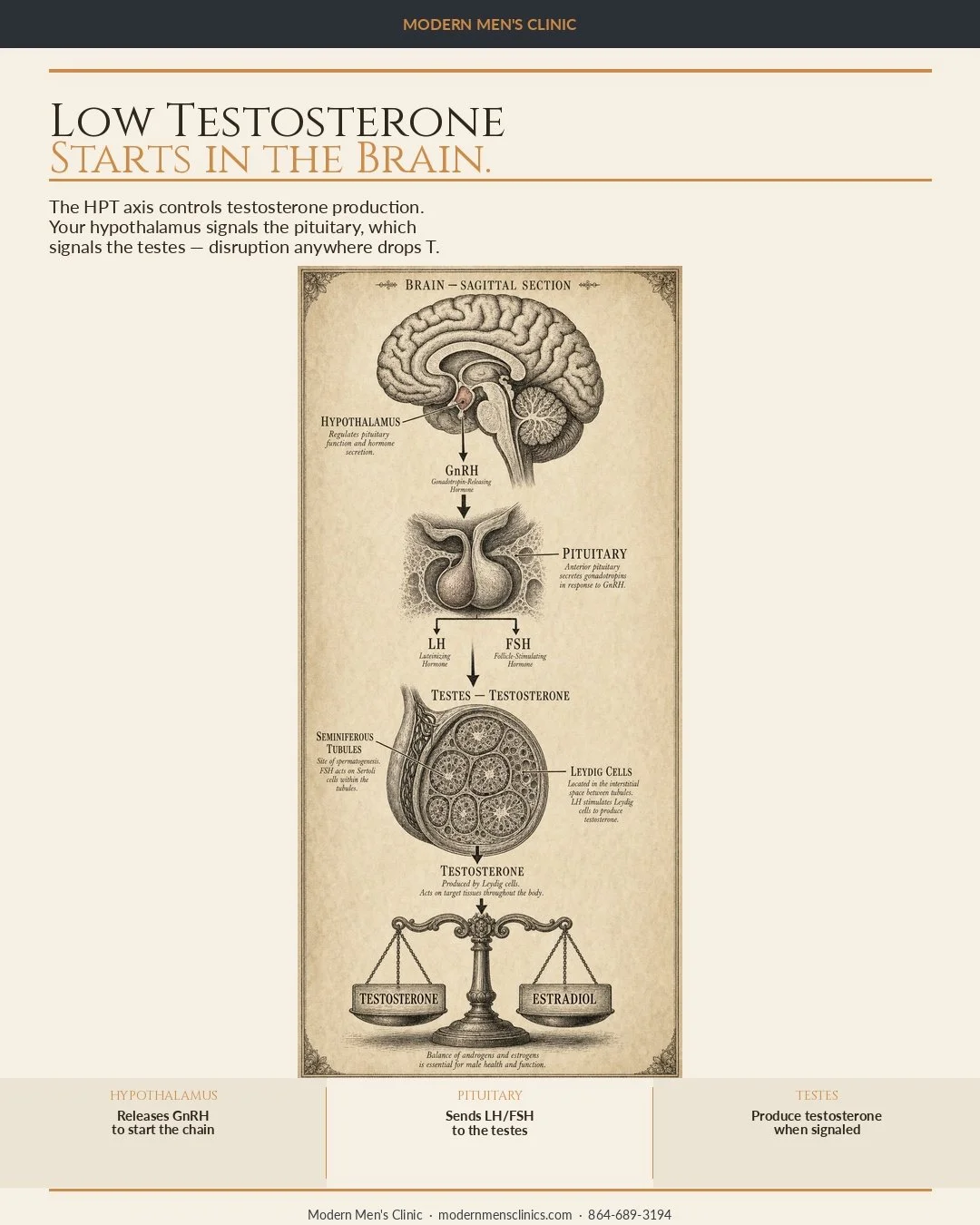
The majority of your daily testosterone is produced during sleep — specifically during REM and slow-wave sleep cycles. The pituitary gland releases pulses of luteinizing hormone (LH) during these stages, which signals the testes to produce testosterone.
When sleep is cut short, fragmented, or poor in quality, those pulses are disrupted. Studies have shown that men who sleep five hours or fewer per night can experience testosterone declines equivalent to 10 to 15 years of aging — within just one week of sleep restriction.
That is not a slow drift. That is a steep drop with measurable consequences.
The Bidirectional Problem
Here is what makes this particularly challenging: low testosterone also worsens sleep quality. Men with low T are more likely to experience:
- Difficulty falling asleep
- Frequent nighttime waking
- Reduced time in restorative sleep stages
- Sleep apnea (which further suppresses testosterone)
Low testosterone disrupts sleep. Poor sleep lowers testosterone. The two problems reinforce each other — and many men are caught in this cycle without recognizing it.
Sleep Apnea and Testosterone
Obstructive sleep apnea is significantly more common in men with low testosterone and excess body fat — two conditions that often occur together. During apnea events, oxygen levels drop and the body produces stress hormones that actively suppress testosterone production.
Men who are treated for sleep apnea frequently see improvements in testosterone levels even before beginning TRT. For some, addressing sleep apnea is a critical first step in hormone optimization.
What This Means for Your Treatment
At Modern Men's Clinic, we ask about sleep as part of every intake evaluation — because sleep quality is both a symptom of hormonal imbalance and a driver of it.
For some patients, improving sleep hygiene and addressing sleep apnea meaningfully impacts their hormonal picture. For others, restoring testosterone through TRT significantly improves sleep quality — often within the first few weeks of treatment.
Both pathways are real, and we assess each patient individually.
Serving Men in Anderson, Pickens, and Greenville Counties
Modern Men's Clinic is located in Piedmont, SC. If you are dealing with poor sleep alongside fatigue, weight gain, or other signs of low testosterone, a comprehensive evaluation can help identify what is actually driving your symptoms.
Sleep is not a luxury. It is when your body produces the hormones that make everything else work. Let's make sure yours is.
Title: Medical Weight Loss for Men Over 40: Why Willpower Is Not the Problem
“Is this just what I have to deal with now that I’m over 40”
You have tried eating less and moving more. You have cut carbs, gone to the gym, tracked your calories. And yet the weight — especially around your midsection — refuses to move in any meaningful way.
If this sounds familiar, here is what you need to hear: the problem is not your willpower. For many men over 40, the problem is biology.
Is this just what I have to deal with now that I’m over 40”
You have tried eating less and moving more. You have cut carbs, gone to the gym, tracked your calories. And yet the weight — especially around your midsection — refuses to move in any meaningful way.
If this sounds familiar, here is what you need to hear: the problem is not your willpower. For many men over 40, the problem is biology.
Why Weight Loss Gets Harder With Age
Several physiological shifts make weight loss increasingly difficult as men get older:
Declining Testosterone
Testosterone plays a direct role in fat metabolism and muscle preservation. As levels fall, the body becomes more efficient at storing fat — particularly visceral fat around the abdomen — and less efficient at building the lean muscle that burns calories at rest.
Insulin Resistance
As men age, cells can become less responsive to insulin, making it harder to process carbohydrates effectively and promoting fat storage.
Metabolic Slowdown
Resting metabolic rate declines with age and muscle loss. This means the same diet that kept a man lean at 30 can lead to steady weight gain by 45.
Hormonal Cascade Effects
Low testosterone leads to higher body fat, which increases estrogen conversion, which further suppresses testosterone. It is a cycle that becomes progressively harder to break without medical intervention.
What Is Medical Weight Loss?
Medical weight loss goes beyond diet advice and exercise plans. It uses clinically proven tools — lab work, metabolic assessment, and prescription medications — to address the biological barriers to fat loss that willpower simply cannot overcome.
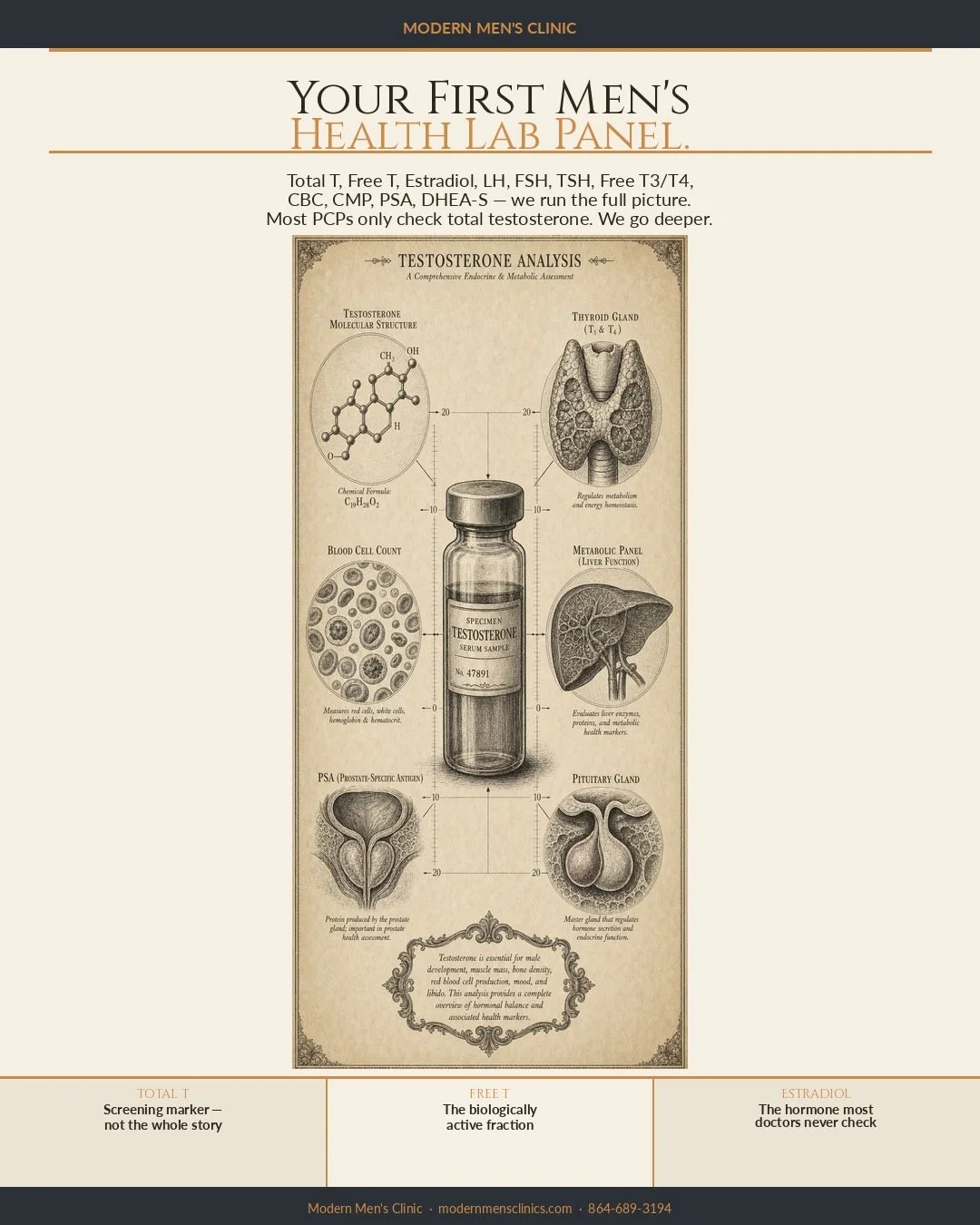
At Modern Men's Clinic, our medical weight loss program is built around each patient's unique metabolic profile. We begin with a comprehensive panel that includes:
- CMP with GFR
- CBC with differential
- TSH reflex to T4
- Hemoglobin A1c and insulin levels
- Lipid panel
- Vitamin B12
- DHEA
- And others if needed
This tells us what we are actually working with — and why your body has been resisting change.
GLP-1 Medications: A Game-Changer for Men
GLP-1 receptor agonists (like semaglutide and tirzepatide) are among the most effective medical weight loss tools available today. These medications work by reducing appetite, slowing gastric emptying for sustained fullness, improving insulin sensitivity, and directly supporting fat loss.
Medical weight loss programs at Modern Men's Clinic typically run four months to one year, depending on goals. GLP-1 medications are available at $250–$500 per month, with initial labs at $101 at the time of this blog post. Many of the labs you need for TRT and medial weight loss are the same.
The Testosterone Connection
One of the most overlooked aspects of men's weight loss is the relationship between testosterone and body composition. Many of our patients are dealing with both low T and stubborn weight — and these two problems are often feeding each other.
When we address both simultaneously, the results are significantly better than treating either one in isolation.
Modern Men's Clinic is located in Piedmont, SC, and serves Anderson, Pickens, and Greenville counties, with telehealth options available statewide.
If any of this sounds like you we would love to work with you just give us a call or fill out the become a client button found here.
What to Expect from Testosterone Replacement Therapy (TRT)
Starting testosterone replacement therapy is a significant decision. Many men begin TRT with high expectations, but understanding what actually happens—both short-term and long-term—is critical for success.
The First Few Weeks
During the initial phase, changes are often subtle:
Slight increase in energy
Improved mood
Better sleep quality
However, dramatic changes typically do not occur immediately.
1–3 Months
This is when more noticeable improvements begin:
Increased libido
Improved mental clarity
Enhanced motivation
Some men also begin to see early changes in body composition.
3–6 Months
Physical changes become more apparent:
Increased muscle mass
Reduced body fat
Improved exercise performance
Sexual function often continues to improve during this period.
6–12 Months
Longer-term benefits include:
Stabilized mood
Sustained energy levels
Improved metabolic health
Bone density improvements may also begin.
What TRT Does NOT Do
TRT is not:
An instant transformation
A substitute for diet and exercise
A cure-all for every health issue
Lifestyle still plays a major role in outcomes.
Monitoring and Adjustments
Successful TRT requires ongoing monitoring:
Testosterone levels
Hematocrit
Lipid profile
PSA (prostate health)
Dosing adjustments are common and necessary.
Potential Side Effects
Some men may experience:
Acne or oily skin
Increased red blood cell count
Fluid retention
Most side effects are manageable with proper care.
Adjunct Therapies
In some cases, additional treatments may be used alongside TRT:
Medications to maintain fertility
Estrogen management strategies
Lifestyle interventions
Psychological Expectations
One of the biggest challenges is managing expectations. TRT can improve quality of life, but it won’t:
Fix relationships
Eliminate all stress
Replace healthy habits
The Long-Term Perspective
TRT is typically a long-term commitment. Stopping therapy can lead to a return of symptoms unless underlying causes have been addressed.
Conclusion
When approached correctly, TRT can be a powerful tool for improving health and well-being. The key is realistic expectations, proper medical supervision, and a commitment to overall lifestyle improvement.

What is the ADAM questionnaire?
It all begins with an idea.
The Androgen Deficiency in the Aging Male (ADAM) questionnaire is a 10-question, self-report screening tool designed to identify symptoms of low testosterone (hypogonadism) in men. It acts as a non-invasive, preliminary check, often used for identifying low libido, fatigue, or mood changes, but it does not provide a definitive diagnosis. This test allows us to make sure you have symptoms of low testosterone and help guide your care to appropriate therapy.
Key points of the ADAM questionnaire
Purpose: Quickly find men who may have low testosterone.
Accuracy: High sensitivity (88%) but lower specificity (60%).
How it’s scored: A test is "positive" if the person answers "Yes" to question 1 (low libido) or question 7 (weaker erections), or "Yes" to any other three questions.
Symptoms checked (10 items)
Lower sex drive
Low energy
Less strength or endurance
Lost height
Less enjoyment of life
Feeling sad or irritable
Weaker erections
Worse sports ability
Falling asleep after dinner
Decline in work performance
If you have answered yes to 3 questions or answered yes to questions 1 or 7 please reach out. We would love to draw some initial lab work to see if we can’t find a cause for how you feel.
